The AI Organization
AI Is Leaving the Screen and Taking a Seat at Your Desk
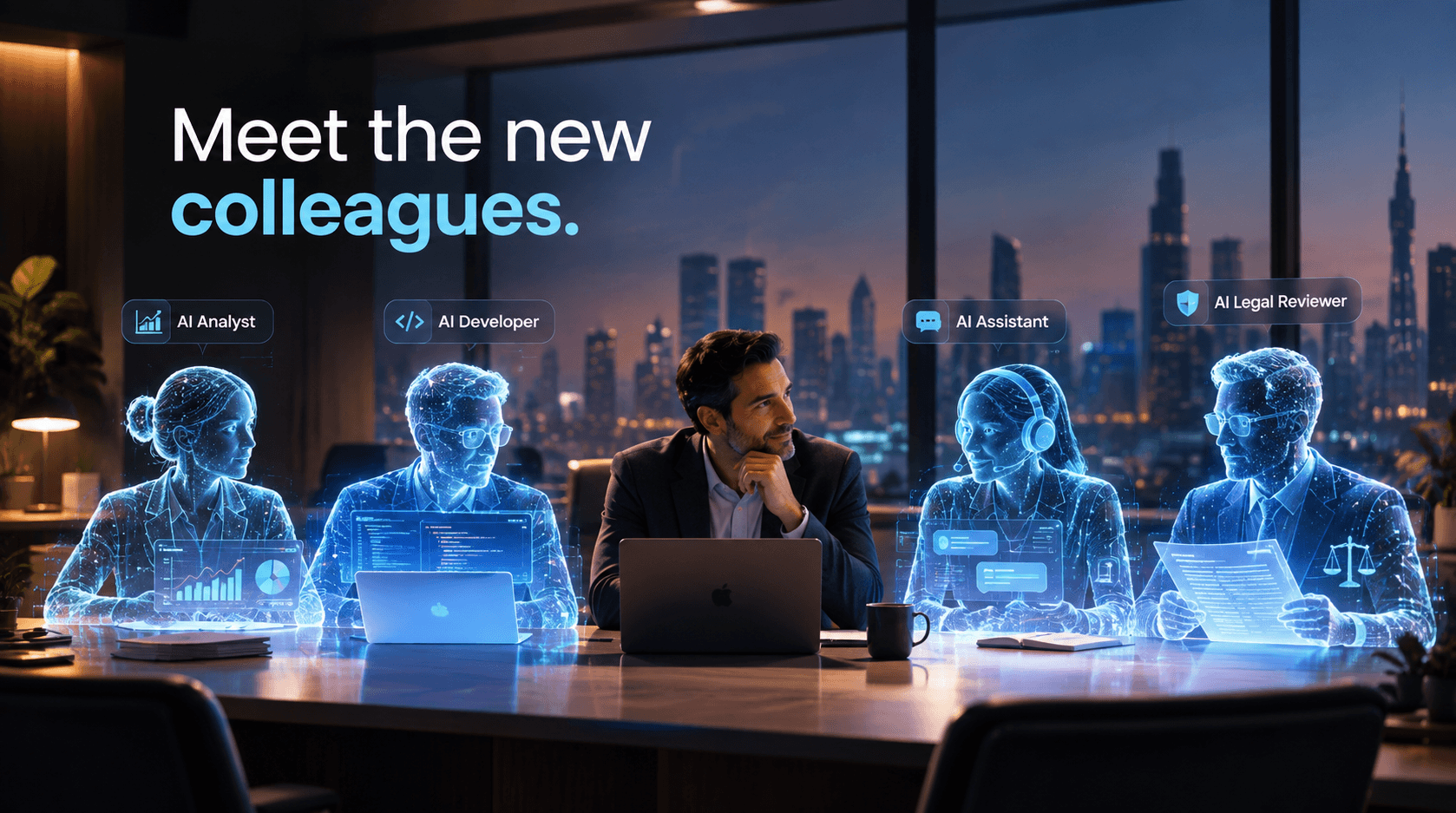
What happens when AI stops being a tool and starts becoming a worker?
For decades, technology lived on our screens.
ERP systems sat behind finance teams. CRM systems sat behind sales teams. Cloud platforms sat behind IT teams.
We opened them. We clicked them. We gave them instructions. We used the software.
AI is different. AI is beginning to work with us.
It drafts the report. It reviews the contract. It analyzes the data. It writes the code. It responds to the customer. It researches the market. It creates the presentation.
And increasingly, it doesn't wait for us to tell it what to do at every step. It takes the task and runs with it.
AI is leaving the screen. It's taking a seat at our desk.
From software we use to work we delegate
Think about how we traditionally interacted with software.
We had a task. We opened an application. We entered information. We navigated menus. We reviewed the output. We made the decision. The software helped us do the work.
Now consider an AI agent. You could say:
"Analyze our top 50 customers, identify accounts at risk, research why they're declining, prepare an action plan and send me the three accounts I should personally call."
The system can potentially plan, research, analyze, execute, and report — end to end.
The human isn't operating the software anymore. The human is delegating work to it.
That distinction may be more important than another improvement in model intelligence.
And that changes the economics
For more than 25 years, I've watched technology transform enterprises through ERP, Cloud, Mobile and Digital Transformation. Each wave automated another layer of the business. But humans remained the workforce making decisions and performing the knowledge work.
AI is different because it is beginning to automate parts of the knowledge work itself.
That's why I believe we're making a fundamental mistake when we evaluate AI purely as a software investment. If an AI agent is performing work that previously required a person, the relevant comparison isn't AI vs. software. It's AI vs. labor.
Consider an AI system performing customer support, document review, software testing, financial analysis, or procurement triage. The real question becomes: what did this work cost us before AI?
Not just the salary. The fully loaded cost includes:
- Salary and benefits
- Management overhead
- Recruitment, training, and onboarding
- Attrition and capacity constraints
- Working hours
Now compare that with the cost of an AI worker:
- Compute and model usage
- Orchestration and integration
- Monitoring and governance
- Human oversight
In some categories of knowledge work, that economic comparison is going to become extremely difficult for businesses to ignore.
Your next teammate may not need a chair
This is where things get interesting.
Today we talk about AI assistants. Tomorrow we will increasingly talk about AI teammates. And eventually, AI workers.
An AI developer doesn't need a desk. An AI analyst doesn't need a laptop. An AI customer-support agent doesn't need a shift schedule. An AI research agent doesn't need a meeting room.
But they can still perform defined responsibilities. They can have a role, a scope, access permissions, objectives, tools, performance metrics, an owner, and human oversight.
So what exactly are they? Software? Or a new category of workforce?
I believe the second description will increasingly make more sense.
The two-headcount enterprise
For more than a century, organizations have measured workforce capacity through one number: employee headcount.
I believe that will eventually change. Leadership teams will begin thinking in terms of human headcount — people performing work — and AI headcount — AI agents performing defined responsibilities.
Imagine a board presentation that says:
Human workforce: 18,400. AI workforce: 42,000.
Not 42,000 employees. 42,000 digital workers performing defined tasks or roles.
That may sound strange today. It won't, once companies start deploying thousands of agents across customer service, software engineering, finance, procurement, operations, and compliance.
The org chart was designed for humans
And here's the bigger problem: our organizations were designed around humans coordinating humans.
Managers manage teams. Directors manage managers. Departments coordinate with departments. Meetings coordinate activities. Reports move information up and down the hierarchy.
But what happens when a manager can delegate work directly to 50 AI agents? What happens when a two-person team can operate the output of a 20-person department? What happens when an AI agent can coordinate with another AI agent without waiting for a human meeting?
The economics of organizational design changes.
This is why I believe the next transformation isn't simply "how do we introduce AI into our existing organization?" The bigger question is: how do we redesign the organization around humans and AI working together?
From human workforce to hybrid workforce
This is the idea behind a framework I've been developing called Dual-Core Agile.
The basic premise is simple: instead of continuously scaling human teams to increase output, organizations create small, highly capable human teams that direct, orchestrate, and govern a much larger AI workforce.
Humans provide judgment, context, leadership, accountability, creativity, and ethics. AI provides scale, speed, execution, analysis, automation, and continuous operation.
The objective isn't to remove humans. It's to change what humans are responsible for.
I'll explore this model in a future article.
The question CEOs should be asking
Most enterprise AI conversations today still sound like this: which model should we use, which AI platform should we buy, how do we deploy Copilot, what's our GenAI strategy?
These are useful questions. But they're not the most important questions anymore.
The questions I would ask a CEO are:
- What work will your AI workforce perform in 18 months?
- Which roles will become AI-augmented?
- Which roles will become predominantly AI-operated?
- How many AI agents will your organization need?
- Who will manage them?
- Who will be accountable when they make a mistake?
And perhaps the most uncomfortable question: if AI can perform 40% of the work currently performed by your workforce, why is your organization still designed around today's workforce?
My prediction
Within this decade, we will stop thinking of AI simply as software. We will think about it as workforce capacity.
Companies will measure not only how many people they employ, but how much productive capacity their digital workforce provides.
And the competitive advantage won't necessarily belong to the company with the most AI. It will belong to the company that knows how to organize humans and AI into the most effective workforce.
AI is already at your desk
The transition has already started.
Today, AI sits inside your browser. Tomorrow, it sits beside you. Eventually, you may not even think of it as software — you'll simply give it a piece of work, and expect it to come back with the result.
The real transformation isn't that AI is becoming more intelligent. It's that we are beginning to delegate work to it.
And once we do that at scale, we aren't just buying technology anymore. We're building a workforce.
The question worth debating: if an AI can take a task from you, execute it, and return the result without you operating the software — is it still a tool, or has it become a worker?
About the author: Mohamed Ismail is an AI thought leader with 26+ years in enterprise transformation and solution architecture on AI, Cloud & Data. He writes on the shift from AI-as-tool to AI-as-workforce.
Part 1 of "The AI Organization" series — exploring what happens when AI stops being a tool and starts becoming a workforce.