The AI Organization
The Org Chart Was Designed for Humans. What Happens When AI Joins the Workforce?
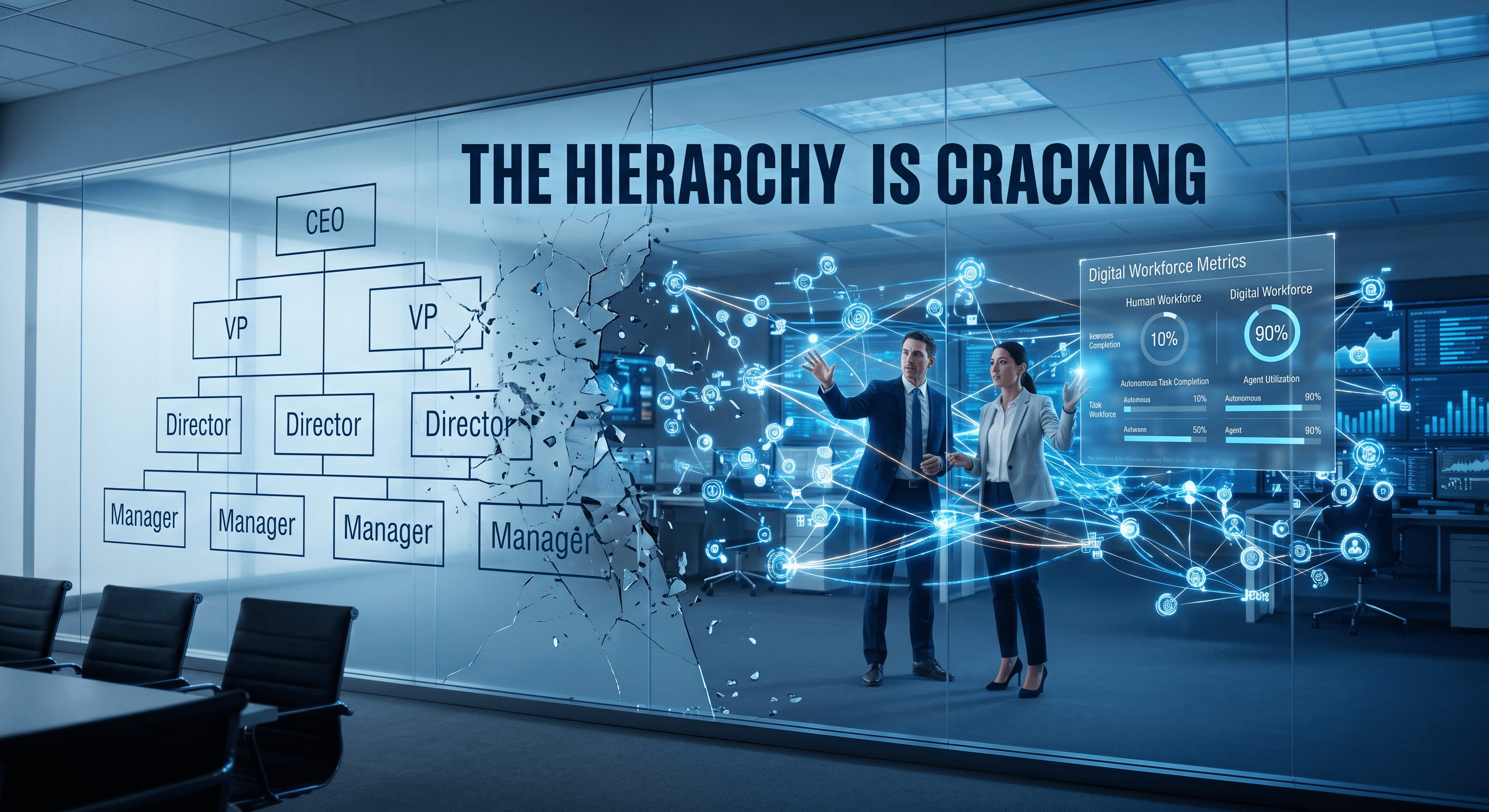
If part of your workforce is no longer human, does your org chart still make sense?
For more than a century, organizations have been built around a simple assumption: people manage people.
Managers manage teams. Directors manage managers. Executives manage departments. Information moves up and down through layers, one level at a time.
The entire org chart was designed around human limitations, not around the work itself.
Meetings exist because humans can't instantly share context. Departments exist because humans can't manage thousands of activities at once. Middle management exists because humans can't coordinate large groups without someone translating between layers.
But what happens when part of the workforce isn't human?
What happens when one manager can direct fifty AI agents instead of five people? What happens when AI agents coordinate directly with each other, without waiting for a meeting? What happens when work scales without headcount scaling at all?
The org chart starts to break.
Why the modern org chart exists
Every layer in a traditional hierarchy exists to solve the same problem: humans have limited attention, limited working hours, and limited ability to hold context across many things at once.
A manager doesn't exist because the work requires management. A manager exists because five or ten people can't coordinate themselves without someone aggregating status, resolving conflicts, and translating decisions between levels.
For more than 25 years, I've watched organizations add layer after layer to solve exactly this problem — not because the layers created value on their own, but because scaling human coordination has no other lever to pull. More people means more coordination overhead means more managers means more layers.
That's not a flaw in how organizations are designed. It's the correct design, given the constraint. The constraint was always that the workforce was entirely human.
AI removes the coordination cost, not just the labor cost
Most conversations about AI and the workforce focus on execution — AI writing the report, AI answering the ticket, AI drafting the code. That's real, and it matters. But it's not the part that breaks the org chart.
What breaks the org chart is that AI agents don't need what coordination exists to provide.
An AI agent doesn't need a status meeting to know what another agent already did — it can query the state directly. It doesn't need a summary from a manager — it can read the underlying data itself. It doesn't wait for a weekly sync to escalate a blocker — it can flag it the moment it happens.
Coordination between humans is expensive because humans can't share context instantly. Coordination between AI agents is nearly free, because they can.
That single difference is enough to reshape what an organization actually needs layers for.
The rise of the two-person department
Consider a department that today runs on twenty people — a mix of individual contributors, team leads, and a manager coordinating the whole.
Now imagine the same output, produced by two humans directing eighteen AI agents.
Today: 20 people. Tomorrow: 2 humans + 18 AI workers.
The two humans aren't doing less important work. They're doing more important work — judgment calls, quality decisions, client relationships, the things that still genuinely require a person. What disappears isn't the value the department produces. What disappears is the coordination layer that used to be necessary to keep twenty people pointed in the same direction.
Why middle management is the most exposed layer
This is the part of the conversation most people avoid, so I'll say it directly: I don't believe AI's biggest impact on the workforce will be at the bottom of the org chart. I believe it will be in the middle.
Look at what a typical manager actually spends their week doing: coordinating handoffs, summarizing status for the level above, escalating blockers, tracking who's doing what. These are real, necessary activities — and they are also exactly the category of work AI is becoming very good at.
This isn't a statement about whether managers are valuable. The parts of management that require judgment, mentorship, difficult conversations, and accountability for outcomes are not going anywhere — if anything, they become more important, not less, once a manager is responsible for a mixed team of humans and AI agents. What's exposed is the coordination work, not the leadership work. Those have always been bundled into one role. AI is what finally separates them.
Introducing Dual-Core Agile
This is the shape of the framework I've been developing, and the one this whole series is building toward: Dual-Core Agile.
The premise is simple. Instead of scaling an organization by continuously adding human headcount, you build a small, highly capable human core — people who provide judgment, context, accountability, and leadership — that directs and governs a much larger AI workforce, which provides scale, speed, execution, and continuous operation.
The human core doesn't shrink because people matter less. It shrinks because coordination between a small group of accountable humans and a large group of AI agents doesn't require the same layers of translation that coordination between hundreds of humans always has.
I'll go deeper into the actual mechanics of this model — how roles get defined, how accountability gets assigned when an AI agent makes a mistake, how governance actually works in practice — in a future piece in this series. For now, the shape matters more than the detail: small human core, large AI workforce, fewer layers in between.
My prediction
By 2035, I believe many enterprises will operate with:
- Fewer management layers than they have today
- More autonomous, self-coordinating teams
- Thousands of AI workers operating alongside a comparatively small human core
Not because organizations decided hierarchy was bad. Because the reason hierarchy existed in the first place — humans coordinating humans at scale — stops being the binding constraint once a meaningful share of the workforce isn't human anymore.
The question worth sitting with: if a manager can achieve the same output with two humans and fifty AI agents, what happens to the department that was built around twenty?
About the author: Mohamed Ismail is an AI thought leader with 26+ years in enterprise transformation and solution architecture on AI, Cloud & Data. He writes on the shift from AI-as-tool to AI-as-workforce.
Part 2 of "The AI Organization" series. Part 1, "AI Is Leaving the Screen and Taking a Seat at Your Desk," is live now. Part 3 asks an even harder question — coming next.