The AI Organization
The Most Vulnerable Job in the AI Era Isn't the Employee. It's the Manager.
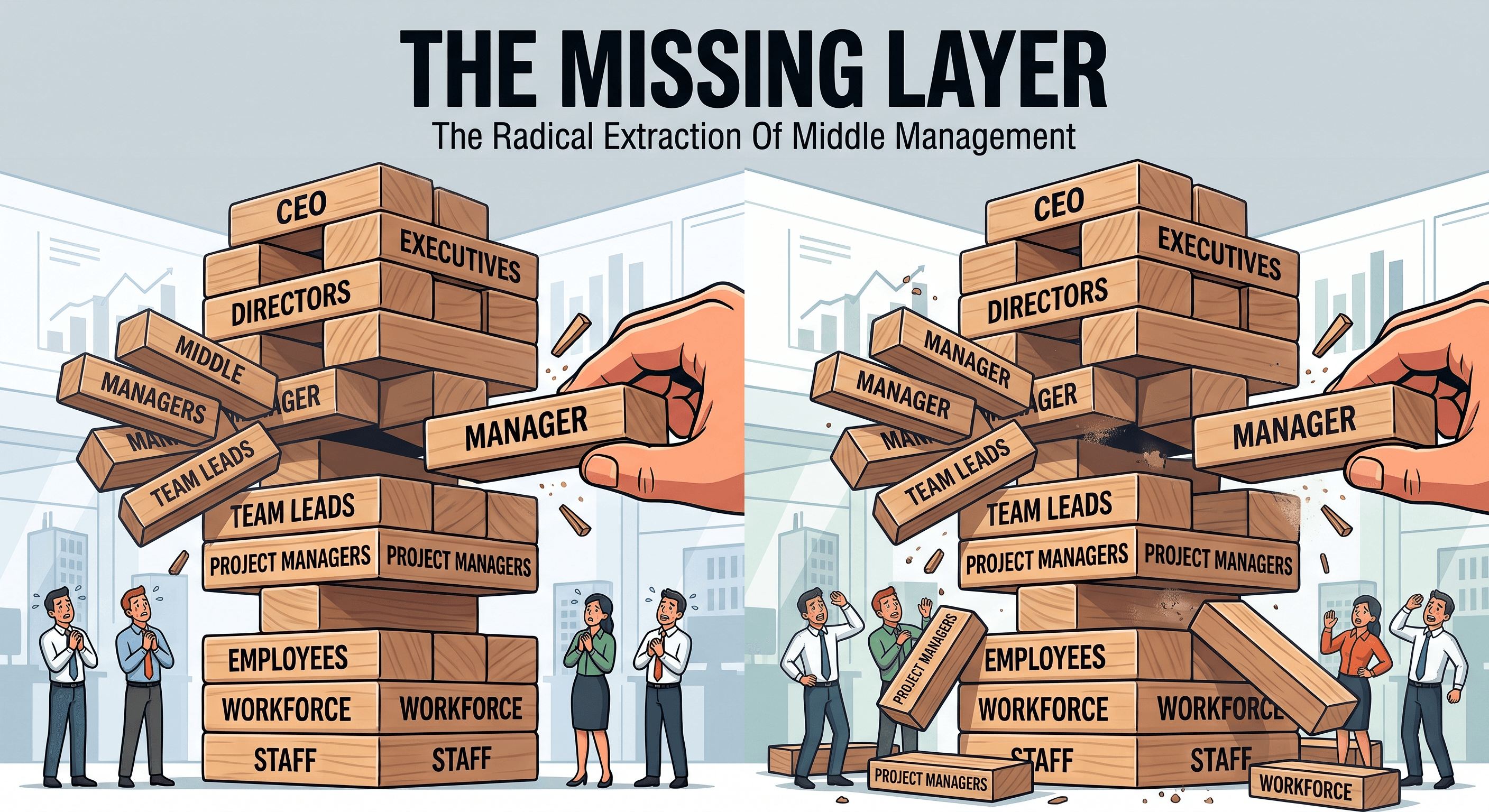
Middle management has a problem — and it isn't the one most people are watching for.
Ask people which jobs AI will replace first, and most answers sound similar.
Customer support. Data entry. Junior developers. Analysts. Administrative roles.
The assumption is simple: AI replaces the people doing the work.
I think we're looking in the wrong direction.
The biggest disruption of the next decade may not happen at the bottom of the organization. It may happen in the middle.
Because many management jobs were created to solve a problem AI is becoming remarkably good at: coordination.
The job nobody wants to describe
Ask ten managers what they actually do, and you'll hear some version of the same list: team coordination, resource allocation, status reporting, escalation management, progress tracking, meeting facilitation, performance monitoring, information sharing.
None of these are trivial responsibilities. But none of them are unique to humans, either. They're exactly the kind of structured, repeatable activities AI systems are becoming increasingly capable of handling.
That should make us uncomfortable.
The meeting economy
Let's be honest about how much of organizational life isn't work — it's coordination around work.
Status meetings. Project updates. Progress reviews. Weekly reviews. Steering committees. Executive summaries. Escalation discussions. Follow-up meetings about previous meetings.
Entire management structures exist because humans can't simultaneously process everything happening across an organization. So we built reporting hierarchies. Managers became the operating system of the company.
But what happens when AI becomes the operating system?
The manager's hidden job
Most managers don't create value directly. They create value indirectly — they help others create it. They collect information, distribute information, prioritize work, resolve conflicts, track execution.
Historically, this was essential. But AI can now monitor thousands of activities simultaneously, detect delays, identify risks, generate reports, recommend actions, and escalate issues automatically — continuously, without meetings, without waiting for updates, without sleeping.
The twenty-person department problem
Imagine a department today: one director, four managers, fifteen employees.
Now imagine the same department five years from now: one director, one manager, three employees, forty AI agents.
The output may actually increase. The organization becomes flatter. The coordination layer shrinks. The management burden decreases. The work still gets done — in some cases, faster.
That's the uncomfortable math executives are beginning to examine.
Why managers shouldn't panic
This isn't a prediction that managers disappear. It's a prediction that management changes.
The best managers won't be replaced. They'll become more important — but their responsibilities will shift dramatically. The manager of the future may spend less time tracking work, reporting status, and managing meetings, and more time providing judgment, setting direction, coaching people, managing AI workforces, and making strategic decisions.
Less supervision. More leadership.
The new management question
Historically, managers asked: "How many people do I have?"
Soon, many will ask: "How many humans and AI agents do I have?"
That's a fundamentally different question, because scaling a workforce of people and scaling a workforce of AI are different challenges entirely. One requires recruitment. The other requires governance.
The rise of the AI Workforce Manager
A role I expect to emerge across large enterprises: AI Workforce Manager — someone responsible for AI capacity planning, AI performance monitoring, agent governance, workforce optimization, and human-AI collaboration.
In other words: managing digital workers, not just human ones.
That sounds futuristic. So did managing cloud infrastructure, once.
The uncomfortable prediction
For decades, organizations scaled output by adding people. I believe many will soon scale output by adding AI workers instead.
And when that happens, the most disrupted role may not be the employee. It may be the manager whose primary responsibility was coordinating human work — because AI doesn't need status meetings, doesn't need weekly updates, and doesn't need organizational politics.
My prediction
The first Fortune 500 company to publicly report:
Human Workforce: 35,000. AI Workforce: 120,000.
already exists in prototype form. The only thing missing is the reporting framework. And when that framework arrives, management itself will be redefined.
The question worth debating: if AI becomes capable of coordinating work, allocating tasks, tracking progress, identifying risks, and escalating issues — what remains uniquely managerial? And more importantly: are we entering an era where leadership becomes more valuable than management?
About the author: Mohamed Ismail is an AI thought leader with 26+ years in enterprise transformation and solution architecture on AI, Cloud & Data. He writes on the shift from AI-as-tool to AI-as-workforce.
Part 3 of "The AI Organization" series. Part 2, "The Org Chart Was Designed for Humans," is live now. Part 4, "The Two-Headcount Enterprise," coming next.